ODI vs T20: Which Format is More Challenging?

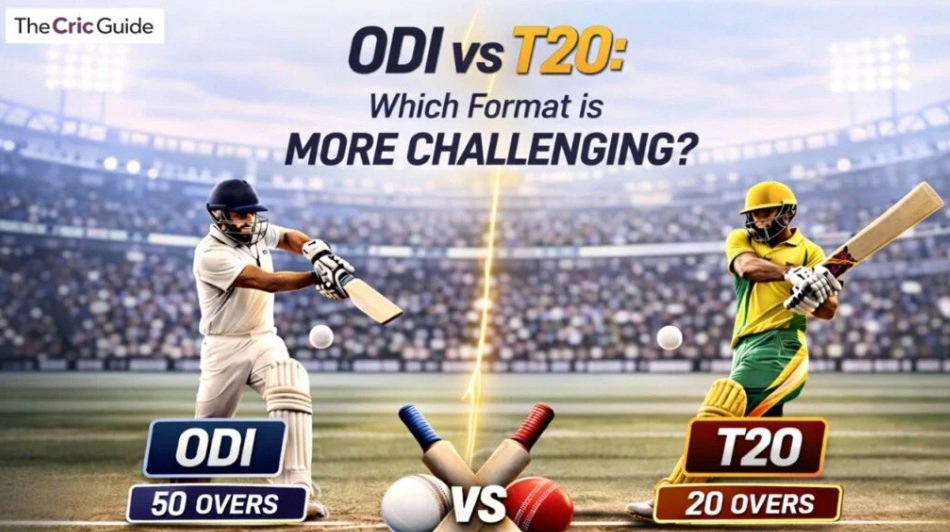
Cricket has changed a lot over the years. From the long Test matches to One Day International and T20 – while the format keeps getting shorter, the intensity and thrill continue to grow. There is one question that never seems to go away with fans and players. When it comes to ODI vs T20, which format actually asks more of a player? Both of these formats are very popular among fans, both have created iconic moments, and both have their own kind of pressure. This article will discuss both the formats in detail so that you can make a conclusion yourself.
Batting: Pace, Patience, and Pressure
Batting is probably the most important aspect of the game when it comes to the shorter format of the game.
ODI Batting Demands a Different Approach
A batter must be able to think in stages in an ODI. In this format, batters get 10 overs at the start as powerplay where only 2 fielders are allowed outside the 30 yard circle. This makes it easier for batters to score more runs. The mid overs should be rotated and partnered. One or two bad overs in the middle phase can be damaging for the team. In the last 7-8 overs, batters try to hit every ball to make a good total.
T20 Format Demands Impactful Performances
In the shortest format, every single ball matters. From the very first ball, you need to score runs. The average run rate of this format is between 8-10 runs per over. Teams look for big hitters in this format as they can take the match away with quickfire knocks.
The main difference between ODI and T20 in terms of batting is that batters get very little time to set on the crease in T20 compared to ODI.
Bowling: Craft vs Execution
Bowling in cricket is a balance between the craft of planning and the execution of delivering under pressure.
ODI Bowling Rewards Strategy
A bowler in ODI gets maximum 10 overs to play with. That is sufficient to prepare a batter, re-enter after a second spell, and to change a plan depending on the behaviour of the pitch. The spinner is able to flight the ball, to draw the batter forward and to place a trap over two or three overs.
Here the skills of a bowler comes into the picture. It is about the economy and also the capacity to pick up wickets during critical times. Here a bowler gets more time to execute their plans.
T20 Bowling Leaves No Margin
In T20s, a bowler gets to bowl only 4 overs. That is why two or even one costly over can result in a turnaround in the game. There is barely any time to recover from a bad over. A yorker half a foot off is a complete full toss and you will be hit for a 6. That is why you need to be precise with your plan, line and length. You can check the detailed stats of the top T20 bowlers on TheCricGuide site to see how they have maintained accuracy to pick up wickets.
ODI vs T20 in Terms of Strategy
ODI strategy revolves around building innings and long-term planning, while T20 demands quick decisions and aggressive, high-impact tactics.
ODI Strategy Runs Deeper
When it comes to strategy, ODI vs T20 comparison has some major differences. A captain must consider the pressure during long periods in an ODI. It includes bowling variations, field positions in the middle overs, and when to bring in the best bowler; all need proper planning.
An ODI has three different phases of powerplay. In ODI games, a team can afford to develop an innings. Batters take some time to be set at the crease at the beginning of the innings and then try to hit more as the innings advance. Bowlers also try to bowl according to conditions and execute their plans to pick up wickets.
T20 Strategy is Reactive
T20 captaincy is all about taking the right decision at the right time because there is almost no time to recover from a mistake. A captain might have to change the plan anytime if it is not working out. The strategy here is more about matchups.
T20 vs ODI difficulty: Fitness and Fielding
The standards of fielding in both formats are high. But T20 has taken the sport of athleticism in the field to a whole new level. Players also dive, pass on throws and make catches along the boundary regularly. Misfields are punished instantly because there are so few overs.
In an ODI, a team fields for around 50 overs. The physical stamina required to remain fit in the 45th over of a bowling innings, when the legs are fatigued, is important to consider. Fatigue also affects concentration and if a fielder drops a catch, it can cost the match.
Both formats demand fitness, but in different ways. ODIs are stamina tests. T20s test explosive power in short bursts.
Adaptability: The Real Test
So, ODI vs T20 which format is more challenging? The answer hugely depends on how easily players can adapt to a certain condition. History shows that adapting is not always smooth.
We see many big hitters who are performing well in T20 cricket, but fail to do so in ODI. It is because they do not have the adaptability. On the other hand, there are many technically sound ODI batters who are not a good fit for T20 because of their inability to hit more.
This is why ICC introduced a separate ranking system for both batters and bowlers. You can check out the current rankings on TheCricGuide website with weekly updates.
Skill Comparison of ODI and T20 Formats in Cricket
If we look at the difference between ODI and T20 cricket formats from a skill perspective, ODIs demand more skillful players. A batter needs to score fast but also preserve wickets. A bowler needs economy but also wickets. A captain needs long-term and short-term thinking.
The cricket formats comparison shows that while T20 is more intense, ODI is more demanding overall. In a T20, one or two big hits can change everything. In an ODI, one player carrying the innings for 40 overs and then finishing it off requires better skill.
This shall clear your doubt on is T20 harder than ODI cricket or not.
Conclusion
The comparison between ODI and T20 cricket will go on. T20 is exciting, fast and has brought millions of new fans to the sport. ODIs are more complete, more strategic, and still offer the biggest trophy in the game: the Cricket World Cup. When you think about everything a player needs to do across 50 overs, the physical effort, the thinking, the ability to plan and then execute, it is hard not to like ODIs as the more demanding of the two. Because at the end of the day, in the comparison of ODI and T20 formats in cricket, there are no easy answers. Only good cricket.